
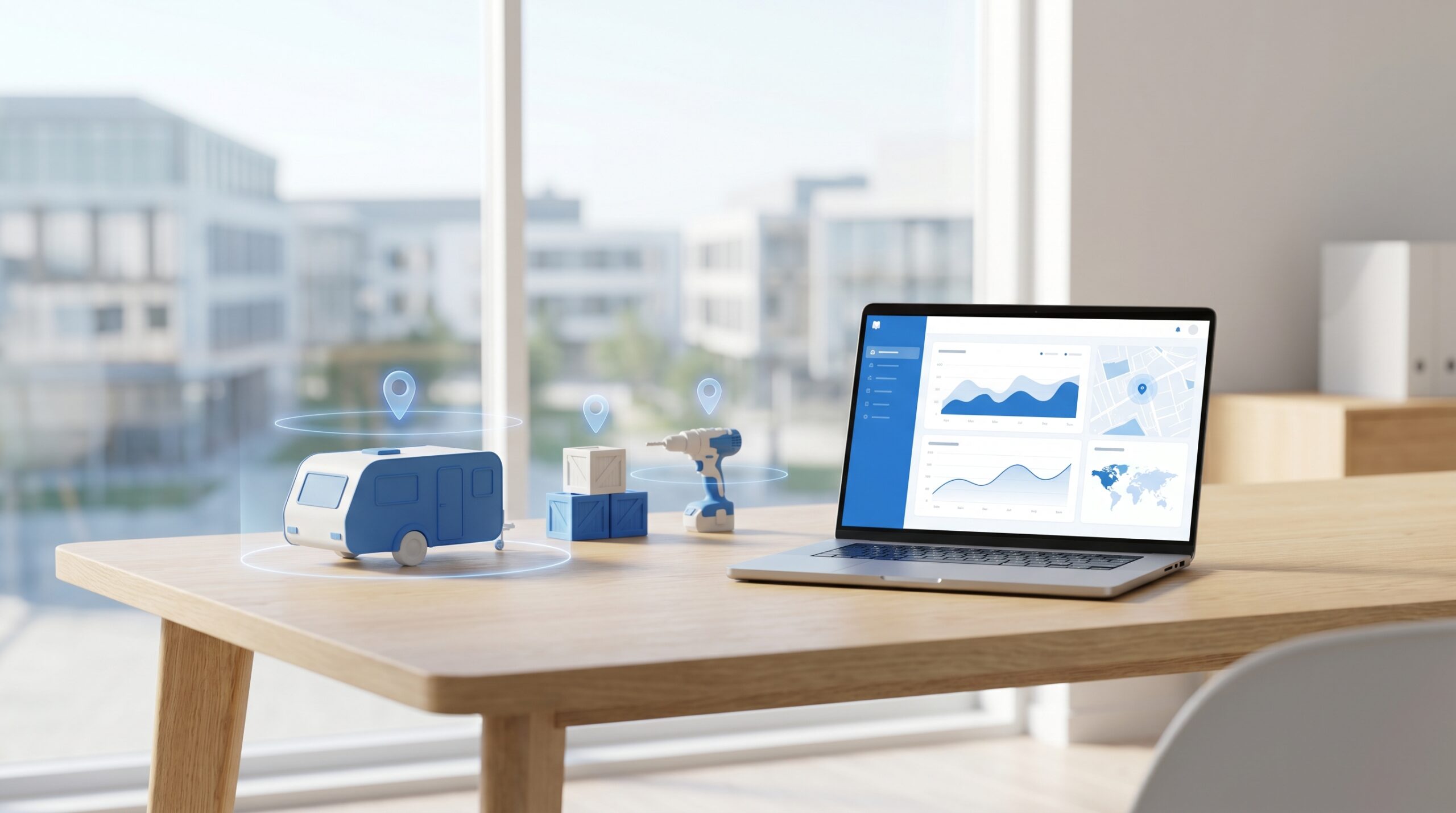
Tracking devices has gone from being a gadget for private individuals to a practical tool for businesses that want to gain control of tools, trailers, machinery and other equipment. For construction companies, service companies, contractors and businesses with many mobile assets, tracking is not just about finding something that has already been stolen. It's about knowing where your company's resources are, who's using them, and when something leaves a place where it shouldn't.
At the same time, the market is messy. There are GPS trackers, Bluetooth tags, non-subscription trackers, consumer products and complete enterprise solutions. Choose the wrong solution and you risk ending up with yet another app, another account and another list that no one in your organisation actually uses.
In this guide, we look at how businesses should think when choosing trackers for tools, trailers and equipment - and why a solution for asset tracking with Boomr Asset often provide more business value than single loose trackers.
Most companies start looking at tracking devices for one simple reason: something is missing. It could be a trailer that's not where it's supposed to be, a measuring device that went with the wrong crew, a toolbox that was left behind on a job site, or equipment that was actually stolen.
But when you start to map out the problem, it often turns out that theft is only part of the picture. At least as much time is wasted searching, phoning around, buying duplicate sets and trying to work out who had what last. This creates unnecessary administration, delays and frustration.
For businesses, therefore, the goal is not just “find the thing on the map”. The goal is to create a system where assets are visible, responsibilities are clear, and history is collected. That's the difference between a tracker as a product and asset tracking as a workflow.
Not all tracking solutions are built for the same situation. A GPS tracker uses satellite positioning and usually sends data via the mobile phone network. It is often well suited for vehicles, powered machinery or objects where you need frequent positioning while moving.
Bluetooth tags work in a different way. They use a short-range signal and, when connected to large tracking networks, can update their position when compatible devices pass nearby. For businesses, it can be a smart solution for tools, bags, trailers, construction equipment and other assets where long battery life, easy mounting and low operating friction are more important than second-by-second positioning.
Boomr Asset is based on modern tags via the Hitta network, allowing companies to track and inventory equipment without each asset needing its own SIM card or complicated installation. This makes the solution particularly relevant for companies that have many small but valuable assets in motion.
| Solution | Best suited for | Strengths | Restrictions |
|---|---|---|---|
| GPS tracker with subscription | Vehicles, machines and objects that move frequently | Tight positioning, good for driving and routes | Often requires SIM, charging or fixed power |
| Bluetooth tag via tracking network | Tools, trailers, bags, equipment and furniture | Long battery life, easy assembly, no heavy installation | Position updated when network devices are nearby |
| Manual inventory list | Small companies with few assets in one place | Cheap to get started | Quickly becomes outdated and lacks alarms, position and history |
| Enterprise solution for asset tracking | Companies with multiple users, workplaces and asset types | Combines tracking, inventory, history, geozones and liability | Requires structure in how assets are recorded and used |
Tools are often more difficult to control than vehicles. They move quickly, are shared between employees, travel between projects and sometimes end up in the wrong car or on the wrong storage shelf. A traditional GPS tracker may be too big, too expensive or require too much maintenance for that type of use.
That's why a robust and discreet tag is often better for hand tools, lasers, measuring instruments, compressors, generators and toolboxes. When each item is digitally recorded, the company can see what is there, where it was last seen and who was responsible for it.
For organisations with many projects, this quickly becomes a productivity issue. If the right equipment is in the right place in the morning, the team doesn't have to start the day searching. If something is missing, it becomes clearer where to start the search.
Trailers, machinery and equipment transported by vehicles are particularly vulnerable. They are often outdoors, change location between working days and can be difficult to monitor manually. This is where the combination of tracking and geo-zones becomes particularly important.
Geo-zones allow companies to define authorised areas, such as a warehouse, construction site or depot. If an object leaves the area, managers can get a signal and check what has happened. It could be a legitimate move, but it could also be the first indication that something is wrong.
For vehicles where logbook, travel and HMRC requirements are the main issue Boomr Fleet. For the equipment located in, on or behind the vehicle, Boomr Asset is a better fit. Together they provide control over both vehicles and assets.
Many people look for trackers without a subscription to avoid ongoing costs. That's understandable, especially if you have a lot of assets to tag. But for businesses, the subscription issue is only part of the equation.
The big cost often arises when equipment is missing, projects are slowed down or someone needs to spend time searching. A cheap tag that is not linked to a functioning inventory system can therefore be more expensive in practice than a solution that creates order from the start.
The right question is therefore: “How do we get control of our assets with minimum administration?” For some items, GPS with a subscription may be right. For many tools and equipment, a tag-based solution with a centralised overview, alarm and history is more efficient.
Tracking answers the question where something is. Inventory management answers more questions: What is it? Who is responsible for it? When was it purchased? Is there a receipt or photo? Has it been lent out? Has it been lost before?
This is where business solutions differ from consumer trackers. In Boomr Asset, assets can be linked to object data such as photo, receipt, purchase date and history. This makes the system useful even when nothing is stolen. It becomes a living inventory that helps the company make better decisions about purchasing, liability and maintenance.
For companies that rent out equipment, borrow between projects or want to clarify responsibilities, tracking can also be linked to procedures and contracts. Then you can Boomr Contract be a natural complement to manage conditions, responsibilities and documentation.
The best way to succeed is to start practically. Don't choose technology first - choose problems first. Identify the assets that are most often lost, cost the most to replace or create the most irritation when they are missing.
A good tracking solution should not create more administration. It should make it easier to see, find and account for your company's assets.
A business tracker is a tag or device that attaches to tools, trailers, machinery or other equipment to display position, history and status in a digital system. For businesses, the value is not just in finding one thing, but in establishing control over the entire asset flow.
Not always. GPS is good for vehicles and powered objects, while Bluetooth tags via the Hitta network are often more convenient for hand tools, bags, trailers and equipment that needs to be tracked without a SIM card or charging.
Yes, some trackers work without a traditional SIM subscription. However, for businesses, it's important to look at the big picture: inventory, users, geo-zones, alarms and support are often more important than the price of the tag itself.
Start with equipment that is expensive, frequently moved between workplaces or often missing when needed: trailers, generators, measuring instruments, machines, toolboxes, lasers and vehicle-mounted assets.
Geozones create digital areas around warehouses, construction sites or vehicles, for example. When an asset leaves the zone, managers can be alerted and act faster before the equipment can disappear further away.
For businesses, the best tracker is not always the smallest, cheapest or most technologically advanced. The best solution is the one that actually makes equipment easier to control in everyday life.
If you want to track tools, trailers, machinery and other company assets, you should choose a solution that combines positioning with inventory management, history, geo-zones and clear accountability. This way, trackers become not just an anti-theft device, but a way to reduce waste, save time and improve control.
Do you want to take control of your company's equipment? Read more about Boomr Asset and order tracking devices for tools, trailers and assets - or contact Boomr and we'll help you choose the right arrangement.

 SV SV
SV SV  NO
NO
 FI
FI
 EN
EN