
An electronic logbook does more than just log miles. For companies with service cars, company cars or a growing fleet of vehicles, it is a way to reduce administration, comply with the Swedish Tax Agency's requirements and at the same time gain better control over how the vehicles are actually used. Many start with paper, Excel or a free template, but this is rarely enough when the number of journeys increases or when reports need to be produced quickly for audits, financial statements or payroll management.
In this guide, we look at what an electronic logbook is, how it works with GPS, what features actually matter and how to choose the right system for your business. We also compare manual and automatic management, and show you when it's time to move to a self-managing solution.
An electronic logbook is a digital system that records journeys automatically or semi-automatically. Instead of drivers manually entering dates, addresses, purpose and mileage after each journey, the information is collected via an installed device, app or GPS tracking.
For businesses, it means that travel data will be more consistently documented. It will be easier to distinguish between private and business travel, keep track of metre readings and export data that can be used for accounting or control purposes.
There are three strong reasons, less administration, better compliance and more control. Manual handling takes time every week, records are easily uneven and it is difficult to get a clear overview when several vehicles are out at the same time.
For companies with multiple cars, the benefits are even greater. As soon as trips need to be authorised, split between private and business, or used for internal follow-up, manual procedures become a bottleneck.
The Swedish Tax Agency requires the documentation to show the date, odometer reading, number of kilometres, starting and stopping points and the purpose of the journey. A manual logbook can work, but it relies on everything being filled in correctly every time.
An electronic logbook reduces the risk of missed data as much is recorded automatically. For companies with company cars, this is particularly valuable as the line between private and business needs to be clear. The less that is left to memory, the more secure the documentation will be.
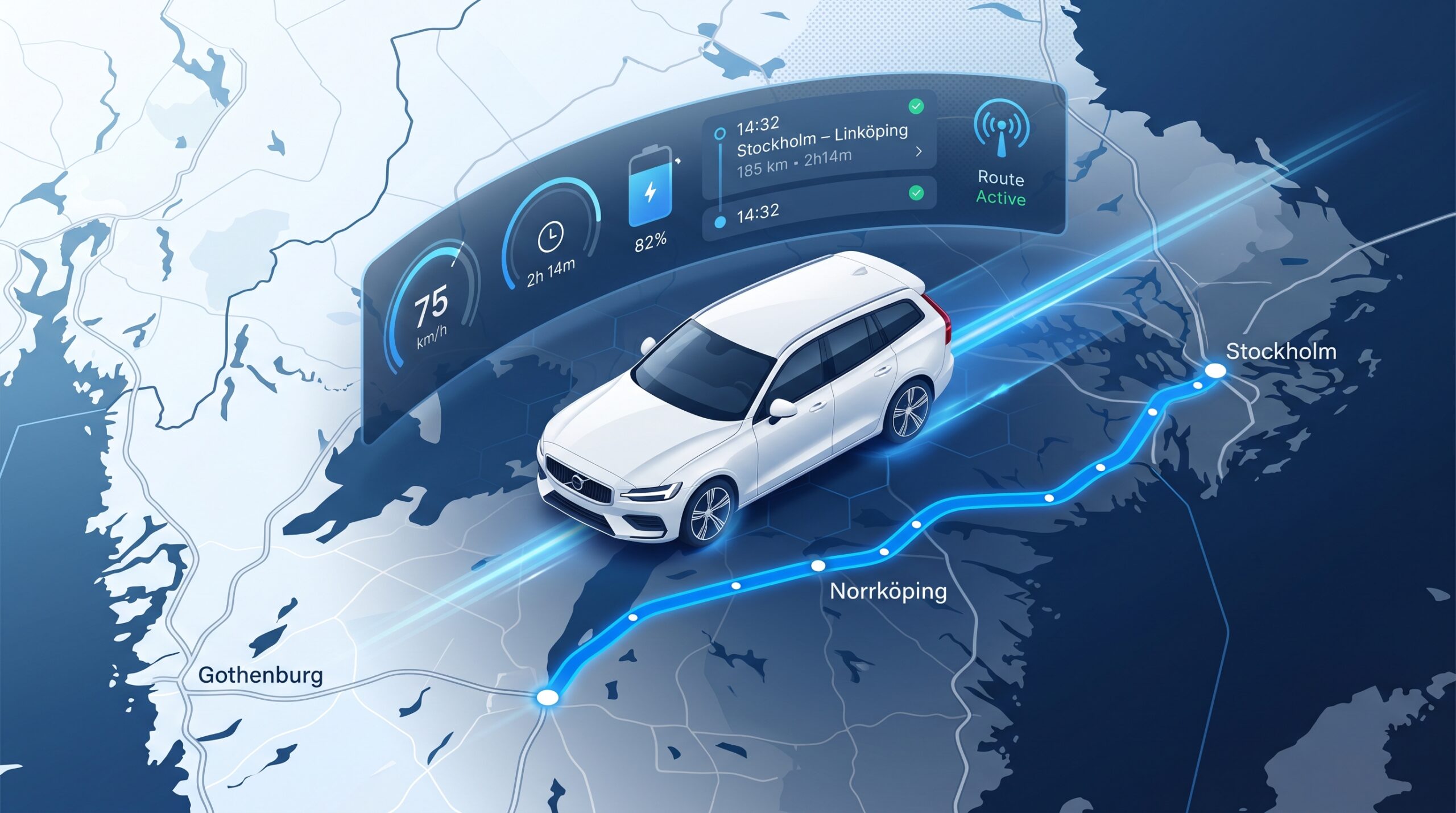
The most effective systems use GPS to record when the car starts, where it goes, how far it travels and when the journey ends. The driver or administrator can then complete or classify the journey as private or business.
Modern systems often do more than that. They can also provide a real-time overview of vehicles, log addresses and routes automatically, manage congestion charges, provide export-ready reports, and link geofences to repeat customer locations. This is where the difference between a simple app and a true enterprise solution becomes clear.
When companies compare options, they often look first at purchase price. This is understandable, but often misleading. The real cost is in the time it takes to keep records up to date and in the risk of errors.
| Comparison | Manual driving log | Electronic driving record |
|---|---|---|
| Registration | The driver fills in everything himself | Journeys are logged automatically |
| Rock risk | High | Lower |
| Time required | High | Low |
| Reporting | Manual collation | Export directly from the system |
| Vehicle overview | None or limited | Often real time via GPS |
| Scalability | Weak | Strong |
For a single car with few trips, a manual solution may work. For companies with more vehicles, recurring customer visits or a need for ongoing follow-up, the electronic model tends to quickly become more profitable.
Not all electronic driving records are built for the same needs. Some focus only on basic logging. Others combine logging, GPS tracking and fleet management.
The less the driver has to do himself, the better quality you get in the data.
It should be easy to classify trips and to follow up on company cars.
The system should be able to export clear reports with the right data points.
If the organisation has service vehicles, field staff or multiple units, this is often crucial.
A solution that is quick to get started will have a faster impact.
Both drivers and administrators need to be able to work smoothly in everyday life.
Many companies start with a cheap or simple solution. This is often reasonable in the beginning. But it tends to become limiting as the business grows or when you need more than a simple logbook.
In this case, it is often better to choose a platform where the journey log is part of a larger fleet management solution.
Many are pushing the same themes, automatic logging, reports adapted to the Swedish Tax Agency, easy installation and better control of the vehicles. The market is clearly moving away from isolated logbooks and towards systems that provide everyday business benefits.
It is also where Boomr Fleet becomes interesting. The solution combines digital driving records with GPS tracking and fleet overview. For companies, this means that the same platform can be used for both documentation and daily management.
Boomr Fleet is built for companies that want to reduce administration but also get more value from their vehicle data.
This means that the system not only helps you to fulfil requirements, but also to work smarter.
The greatest benefit is often found in craft businesses with service vehicles, sales teams that drive a lot between customers, businesses with company cars, organisations that want to reduce administration around mileage reimbursement and companies that want to link driving data to operations, planning and monitoring.
If you have more than a couple of cars in your business, the effect is quickly noticeable. A few minutes saved per journey or per week becomes many hours over a year.
When evaluating an electronic driving licence, it is wise to consider the whole picture, not just the subscription or the hardware.
In many cases, the decision becomes easier when you consider the actual cost of a manual procedure in terms of time, disruption and uncertainty.
An electronic logbook is no longer just a paperless tool. For many companies, it is part of a larger system for control, monitoring and more efficient vehicle operation.
If you want a solution that both fulfils the Swedish Tax Agency's requirements and provides better control of vehicles in everyday life, it is smart to choose a system that combines driving logs with GPS and fleet management.
Ready to try? Book a demo of Boomr Fleet
Yes, an electronic driving record can be used as long as it contains the right information and provides a sufficient basis. The advantage is that much is recorded automatically, reducing the risk of errors.
In practice, the terms are often used synonymously. Often both refer to the fact that journeys are recorded digitally in a system rather than on paper.
It depends on the solution. The best systems log the start, stop and mileage automatically, while the driver mainly marks whether the journey is private or on business.
Yes, especially if your company has several recurring trips, a company car or wants to reduce administration. Even small businesses can save a lot of time.
Yes, if the solution is based on GPS, you can often get a real-time overview of vehicle positions and movements. This is a big advantage for companies with multiple vehicles or staff in the field.

 SV SV
SV SV  NO
NO
 FI
FI
 EN
EN